Policy briefV3.7
Put Children First
We honor our children when we truly make their wellbeing the heart of how we live. Then, working together stops being a sacrifice and starts being care, and simply the right thing to do. Do they deserve less?
We were all children once. The world we grew into is the answer to whether we were honored.
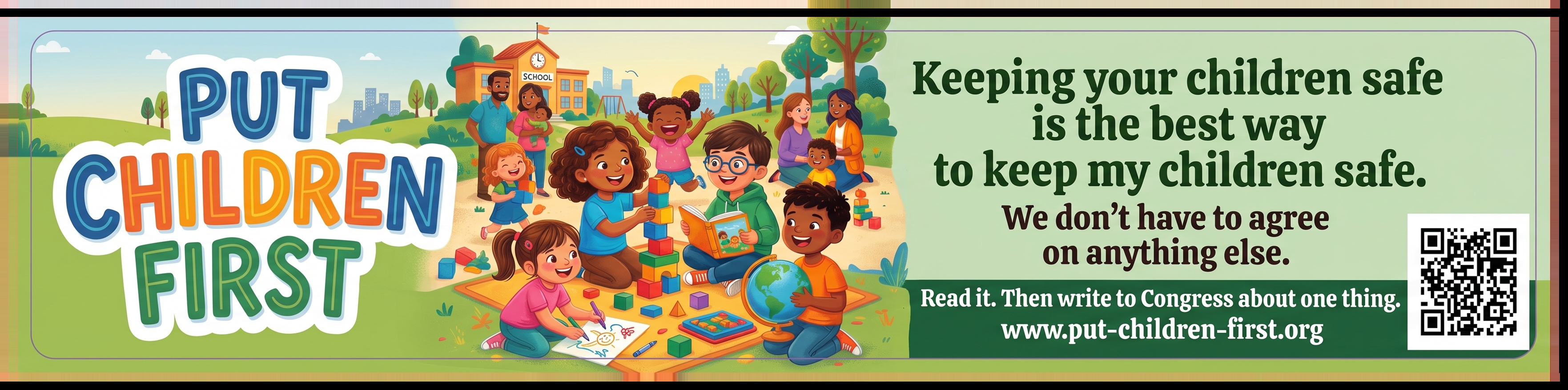
Keeping your children safeis the best wayto keep my children safe.
We don't have to agreeon anything else.
Our children come into the world brimming with humanity. We honor ourselves by honoring them. But that stays a feeling until it becomes a decision rule, and the rule is simple. When the interest of a child and the interest of an adult conflict, the child wins. This page sets out what United States policy would change if the country applied that rule, what it would cost, and what it would save.
The rule Almost every country has already agreed to this rule. The United States is the only UN member state that has not.
"Put children first" has three parts. All three are necessary.
Show it
Every law, budget line, and public service must show its effect on children before anyone approves it.
Decide it
When the interest of a child and the interest of an adult conflict, the child wins.
Measure it
The state measures the result each year and publishes it.
The second part changes policy. The first and third parts only make the second part visible.
The test
Apply one question to any policy. Does this policy improve the life of a child who has no vote, no money, and no lawyer?
A policy passes if the answer is yes. A policy fails if the answer is no. A policy also fails if nobody measured the answer.
Why children lose now
Children lose for three structural reasons, not because anyone intends harm. They do not vote, and politicians answer to voters. They do not own property, and budgets follow property and income. They cannot sue, and courts hear the parties in front of them.
The rule corrects for those three facts. Everything else on this page follows from that correction.
What the rule does not do
The rule binds the state, not the family. Every change on this page acts on something a government controls: a budget, a court, a school, a standard, a platform, a treaty. None of them tells a parent how to raise a child. When the page says the child wins, it means the child wins against a public choice that would otherwise be made for the convenience of adults, and not against a parent at a kitchen table.
On scope, this page is about policy for children who are born, from birth to 18. It takes no position on abortion, and no argument here depends on one.
It already runs somewhere
The rule is not a thought experiment. Wales put a duty on its ministers to have due regard to the Convention in 2011, and was the first country in the United Kingdom to do it. Scotland went further and made the Convention part of domestic law in July 2024, creating binding duties on public authorities. New Zealand passed a Child Poverty Reduction Act in 2018 that fixes measures in statute, requires ten-year and three-year targets, and forces a public report against them every budget.
Those are the three parts of the rule, already working: show it, decide by it, measure it. None of those countries collapsed, and none of them took children away from their parents.
The treaty
This rule is Article 3 of the UN Convention on the Rights of the Child. In all actions concerning children, the best interest of the child shall be a primary consideration. Read narrowly, that means schools and custody courts. Read honestly, it means almost every decision a government makes, because there is no choice about the air, the water, the budget, or the peace that does not concern a child who has to live in the result. The United States signed the Convention in 1995 and has never sent it to the Senate for a vote. Somalia ratified in 2015. Since then the United States has been the only UN member state outside the treaty.
This is a pattern, not an exception
Human rights
The United States signed the Convention on the Rights of the Child in 1995. It has not ratified it. It signed the Convention on the Elimination of All Forms of Discrimination Against Women in 1980. It has not ratified that either. Five other UN members stand outside that treaty: Iran, Palau, Somalia, Sudan, and Tonga. It signed the International Covenant on Economic, Social and Cultural Rights in 1977, and that one still waits. The Senate voted on the Convention on the Rights of Persons with Disabilities in 2012 and defeated it, 61 to 38. A treaty needs two thirds. The Foreign Relations Committee approved it again in 2014, and it never reached a second vote. The United States never signed the International Convention on the Protection of the Rights of All Migrant Workers.
The environment and the sea
The United States signed the 1994 agreement that carries out the UN Convention on the Law of the Sea. It ratified neither that agreement nor the 1982 convention behind it. The Navy and the State Department have asked for ratification under every president since Reagan. It signed the Convention on Biological Diversity in 1993 and has not ratified it. Here too it stands alone. No other UN member state is outside that treaty.
Other long-standing holdouts
It signed the Comprehensive Nuclear-Test-Ban Treaty in 1996. The Senate rejected it in 1999. It signed the Rome Statute of the International Criminal Court in 2000, then withdrew the signature in 2002. It never signed the Mine Ban Treaty. It never signed the Convention on Cluster Munitions. Most International Labour Organization conventions remain unratified, including the one that sets a minimum age for work.
Signing and ratifying are different acts. A signature says a government accepts the text. Ratification is the Senate vote that makes it binding law. The United States signs, and then stops. That is the point of the list. A country that accepts no outside standard answers to none. Children have the least power of anyone to insist on one.
Where money goes The federal government spends about $6,860 a year on each child and about $40,050 on each adult over 65.
That is 5.8 times more per older adult than per child. The Penn Wharton Budget Model uses wider age groups and finds a larger gap. In fiscal year 2025, retirees received 38.6 percent of all federal spending. People under 26 received 10.3 percent.
Federal spending on children was $532 billion in 2024. That is 8 percent of the federal budget. The Urban Institute projects 6 percent by 2035. The share falls because spending on children is discretionary and spending on older adults is automatic. Discretionary spending must be voted through every year. Automatic spending pays out by formula unless Congress acts to stop it. Children are in the part of the budget that has to win an argument annually.
The obvious objection
Most of that $40,050 is Social Security and Medicare, and people paid into both across a working life. That is true, and this page does not propose taking it from them. Nobody should read the comparison as an argument for cutting a pension that was earned.
Read it instead as evidence for the rule at the top of this page. Money follows contribution. Older adults contributed, so the system pays them automatically and forever. Children have contributed nothing, so they get whatever is left after an annual vote. That is not a scandal about older people. It is the exact mechanism this page describes: a budget tracks the people who paid in and the people who vote, and a child is neither. The fix is not to spend less on the old. It is to stop treating spending on the young as the part that can wait.
What changes
Add a child impact statement to the budget process. The Congressional Budget Office must report, for every bill, the effect on child poverty, child health coverage, and child housing stability over ten years. No committee votes without it.
This is the first change, because it costs almost nothing and it makes every later argument factual.
The honest cost
The statement will show that some popular programs for adults are funded by leaving children poor. Nobody can un-see that.
Cash to families In 2021 the child poverty rate fell to 5.2 percent, the lowest ever recorded. One credit expired, and it returned to 13.4 percent.
The expanded Child Tax Credit of 2021 paid families monthly and paid the poorest families in full. It cut child poverty by nearly half in one year. Estimates of the number of children lifted out of poverty range from 2.1 million to 3.7 million, depending on the measure. Families spent the money on food, rent, and school costs. Employment did not collapse.
Congress let it expire in December 2021. Child poverty then returned to its earlier level. This is the clearest natural experiment in modern American social policy, and it ran in both directions.
What changes
Make the credit fully refundable and pay it monthly. Fully refundable means that a family receives the whole amount even when it owes no income tax. Today the credit is only partly refundable, so the poorest families get the least of it. The 2021 design is the working model. A credit tied to a parent's earnings gives least to the children who need most.
The honest cost
About $100 billion a year. Some studies find a small reduction in work by second earners. The evidence for a large work effect is weak. The evidence for the poverty effect is strong and immediate.
A child cannot earn. A payment tied to a parent's earnings punishes the child for the parent's labor market. The rule forbids that.
The first five years The only public investment with a measured return of 13 percent a year. The United States is the only OECD country with no paid parental leave.
- Care price
- $13,184 per child per year, national average, 2025. Infant care is $14,802.
- Federal standard
- Affordable care costs 7 percent of household income or less.
- States that meet it
- None, for center-based infant or toddler care.
- Paid leave
- The OECD is the group of 38 rich democracies. The other 37 members all provide paid maternity leave. The United States provides none.
What changes
Leave
Paid parental leave of at least 12 weeks, available to both parents. Pay it by social insurance, which means a shared national fund built from payroll contributions, in the way that Social Security works. A single employer does not carry the cost, so a small employer has no reason to avoid hiring a young woman.
Care
Public funding of care from birth to age five, with the family payment capped at 7 percent of income.
Staff
Pay early years staff at parity with primary school teachers. Low pay is the reason places are scarce.
The evidence
High quality programs from birth to five return about 13 percent a year for each child. The return appears in education, health, adult earnings, and reduced crime. That figure comes from long follow-up of the Abecedarian and CARE trials. Programs that start at age three or four return 7 to 10 percent. Earlier is worth more.
The honest cost
This is the most expensive item on this page. It is also the only item with a measured return that beats the stock market.
Schools Fund the child, not the address. Two neighboring Pennsylvania districts spend near $30,000 and under $15,000 for each student.
Local property tax funds schools. Districts with expensive houses have well funded schools. Districts serving the most students of color receive about $1,800 less for each student. Along the 100 most segregating district boundaries, the gap in local revenue averages $4,119 for each student.
Lower Merion in Pennsylvania spends near $30,000 for each student. Philadelphia, next door, spends under $15,000.
What changes
Fund schools per child, and weight the funding by need. The state pays first and pays most, instead of the local district. Local money may add to the state amount only if the state matches the same addition for the poorest districts.
The evidence
An increase of $1,000 for each student, held for four years, raises college attendance by about 2.8 percentage points.
The honest cost
This is the hardest political fight on this page. House prices in well funded districts already include the value of the school. Changing the funding rule transfers that value. Homeowners will resist, and homeowners vote.
A child does not choose an address. Funding education by address makes the accident of birth the main fact about a child's schooling. The rule forbids that.
Health Enroll every child at birth and never ask again. Enrollment forms remove children that the law says are covered.
The United States infant mortality rate was 5.1 deaths for every 1,000 live births in 2024. That is 71 percent higher than the average of comparable countries. Sweden is 2.3. Japan is 1.9.
The One Big Beautiful Bill Act of 2025 cut close to $1 trillion from Medicaid. The Congressional Budget Office estimates that 11.8 million people lose coverage by 2034. Child enrollment in Medicaid and CHIP, the Children's Health Insurance Program, fell by at least 2.1 million between January 2025 and May 2026. Several causes contributed, and new paperwork rules are one of them.
What changes
Make coverage automatic and continuous from birth to age 19. Enroll at birth with the birth certificate. No renewal forms. No waiting periods. No work test applied to a parent that removes a child's cover.
The honest cost
Automatic enrollment costs money, and it removes a control that some states use to limit spending. It also removes the main mechanism by which eligible children lose cover, which is paperwork.
A child cannot complete a renewal form. Losing cover because a parent missed a deadline is a penalty on the wrong person.
Safety Since 2020, firearms have killed more American children and teenagers than anything else.
Firearms became the leading cause of death for people aged 1 to 19 in 2020, and have stayed there. Nearly 22,000 people aged 17 and under died by firearm between 2014 and 2024. The rate peaked in 2022, at 3.5 deaths for every 100,000 children, and fell to 3.0 by 2024. Most child firearm deaths involve a gun kept in a home.
What changes
Two measures have the clearest evidence for children.
The first is a storage duty. The owner must keep a gun locked, and unloaded, when it is not in use. If a child gains access, the owner is liable. This is the measure that acts on the largest group of child firearm deaths, because most of them involve a gun kept at home.
The second is enforcement of two laws that many states already have. A child access prevention law makes it an offense to leave a gun where a child can reach it. An extreme risk protection order lets a court take guns from a person for a set period, after a judge finds that the person is a danger. Both laws exist on paper in many states. Neither is funded.
The honest cost
This is the sharpest collision on this page between an adult constitutional interest and a child's life. The rule does not remove the adult right. It places the storage duty on the adult who chose to bring the weapon into the child's home.
The cheap laws Child marriage is legal in 34 states. Schools may hit children in 18. Neither costs money to fix.
These three items survive because of inertia, not because anyone defends them with evidence. They are the cheapest changes available.
Child marriage
Child marriage is legal in 34 states as of May 2026. Seventeen states and the District of Columbia have banned it completely. Four states set no minimum age at all when a waiver is granted. Change: set 18 as the minimum age of marriage, with no exception, in every state.
Physical punishment
Public schools may hit children in 18 states. Private schools may do so in 45. Use is concentrated in the Deep South. The research finds that physical punishment does not improve behavior and does increase aggression. Change: prohibit physical punishment of a child in any school that receives public money.
Child labor
At least 16 states have introduced bills to weaken child labor protection since 2023. Iowa expanded hazardous work for children as young as 14. Kentucky allowed some employers to hire children at age 12. Federal child labor violations in fiscal year 2025 were the highest since the Great Recession.
Change: set a federal floor that states cannot go below. Restore hour limits during school terms. Raise penalties above the value of the labor saved. Fund inspection.
The honest cost
Almost none for the first two. Some employers in agriculture, meat processing, and food service depend on young labor, so a few prices rise. Nobody has produced a child-first argument for a 14-year-old on a roof.
Children and the state Thirteen states set no minimum age for adult prosecution. Immigration detention has separated about 60,000 citizen children from a parent.
Justice
Thirteen states set no minimum age at which a child can be prosecuted as an adult. Georgia, Texas, and Wisconsin routinely charge 17-year-olds as adults. The most common minimum age of criminal responsibility worldwide is 14.
Change: set a minimum age of criminal responsibility at 14. End adult prosecution and adult confinement for anyone under 18. Keep serious offenses in a juvenile system that has the power to hold a young person and the duty to educate them.
The honest cost: serious violent crimes by 16- and 17-year-olds will carry shorter maximum sentences. Victims and their families will object, and their objection is real. The counter-argument is that adult prison raises the chance that the same young person offends again.
Immigration
An estimated 400,000 interior immigration detentions between January 2025 and April 2026 affected about 205,000 children. About 145,000 of those children are United States citizens. About 60,000 citizen children had a parent detained. Arrests have taken place near schools and bus stops.
Change: make schools, clinics, shelters, and courts protected places, with no enforcement action inside them or next to them. Require a review of the effect on children before the detention of any primary caregiver, which means the adult a child depends on from day to day. Prefer alternatives to detention when a child depends on that adult.
The honest cost: enforcement becomes slower and more expensive. The rule does not decide the immigration question. It decides who pays for it. A citizen child is not an instrument of enforcement against a parent.
Housing More than 1.5 million students had no stable housing in 2023-24. That is the highest number on record.
The count rose 12.6 percent in one year and 28.5 percent in two. In New York City, more than 154,000 public school students had no permanent home in 2024-25. That is nearly one child in seven. Housing assistance is not an entitlement. An entitlement pays everyone who qualifies, and its budget is not capped. Housing assistance is capped, so most eligible families receive nothing and wait for years.
What changes
Give a household with a child priority for housing assistance. Make assistance an entitlement for households with children below a set income. Give a family with a school-age child a right to counsel in eviction proceedings, which means a lawyer paid for by the state. Landlords have lawyers in almost every eviction case. Tenants rarely do.
The honest cost
High, and it competes directly with early years funding. Housing instability damages school results, physical health, and mental health at the same time. The return therefore appears in other budgets rather than in this one, which is why no single department will pay for it.
Online Regulate the design, not the speech. Courts have blocked the state laws that regulate speech.
Congress has argued about children online for years and passed nothing. States moved first, and the courts have drawn a clear line through their attempts. Laws that restrict what a child may read get blocked on First Amendment grounds. Laws that restrict what a company may do to a child survive.
That line decides the policy. Age assurance, meaning a check a platform makes on a user's age, puts the burden on the reader and runs straight into the blocked category. Design rules do not.
What changes
Place the duty on the platform, not on the parent. For any account that belongs, or probably belongs, to a minor, prohibit three things. Set every default to the most private setting.
Ranked feeds
A feed sorted to hold attention for as long as possible, instead of one that shows what the child asked to see.
Streaks
A reward for using the app every day, which is removed if the child stops. It punishes the child for leaving.
Tracked ads
Advertising aimed at the child from a record of what that child watched, searched, and paused on.
The honest cost
Age assurance creates a privacy problem for adults. Design rules are the narrower path, because they restrict what a company may do to a child rather than what a child may read. That distinction is also why design rules survive in court.
What they inherit A billion children live where climate shocks are extreme. Plastic now crosses the placenta. No child chose either.
A child cannot move country, choose an industry, or vote on a standard. A child breathes faster than an adult, eats and drinks more for each kilogram of body weight, and has a brain that is still being built. The same exposure does more damage to a child, and it does it at the moment when the damage lasts longest.
Climate
UNICEF counts about one billion children in the 33 countries where the risk from climate and environmental shocks is extremely high. That is close to half the children on Earth. Some 2.4 billion children face at least one climate hazard, 1.1 billion face three or more at the same time, and 850 million face four or more. Exposure to heatwaves has risen from 820 million children in the 2021 index to 1.5 billion in the 2026 report.
These children burned none of the fuel. They will carry the consequences for eighty years.
Lead and air
This is the part of the environmental case that is settled, and it is the strongest evidence on this page for the value of acting early. Children under five lost about 765 million IQ points to lead in 2019. The global cost of lead exposure that year was put at $6 trillion, or 6.9 percent of world output, which is the same order as the cost of fine particle air pollution. The measured United States cost is about $50.9 billion.
The reverse case is also measured. When the country removed lead from fuel and paint, children gained about five IQ points on average, and economists put the lifetime value at $100 billion to $200 billion for each year of births. That was a regulation, not a discovery. The gain came from a decision.
Plastic
The newer evidence is not settled. Microplastic particles have been found in the placenta, in amniotic fluid, in the umbilical cord, and in fetal membranes. Exposure continues after birth through feeding, house dust, and indoor air. Studies link the particles to inflammation and to reduced placental function, and from there to preterm birth and restricted growth.
The link to later neurological and behavioral effects is suggested by animal work and by early human studies. It is not proved. But the exposure is universal, involuntary, rising, and starts before birth. That combination normally justifies acting before the proof is complete.
What changes
Set exposure limits on the child, not on the average adult. A standard calculated for a 70 kilogram adult does not protect a 10 kilogram infant who breathes faster and is still growing a nervous system. Where a limit exists, set it at the level that protects the most sensitive body in the population, which is nearly always a fetus or an infant.
Fund the measurement. The lead case was won because the exposure was measured in children's blood for decades. Nothing similar exists for plastics.
The honest cost
Standards written for the most sensitive body are the most expensive standards to meet, and industry will say so with real numbers. Acting before the science is complete also means sometimes acting on a risk that turns out to be small, and that money cannot be recovered.
The reply is the asymmetry. If a limit is too strict and the risk was small, a company loses margin. If a limit is too loose and the risk was real, a generation carries it, and no later decision can take it back.
The war budget One hundred warheads, used on cities, would starve two billion people. The world holds nearly ten thousand.
Every section above competes for money. This section is where the money is.
World military spending reached $2.9 trillion in 2025. That is 2.5 percent of world output. The United States spent $954 billion of it, a third of the world total. Cumulative spending since 1949 passes $100 trillion on any measure. Different start years and price bases give different totals, and each of them is a number that has no equal in any other category of public spending.
The nuclear line
The Congressional Budget Office puts the cost of United States nuclear forces at $946 billion for 2025 to 2034. That is about $95 billion a year to operate, maintain, and replace them. The estimate is 25 percent above the previous ten-year estimate. It also excludes most of the cost growth on the new Sentinel missile, which the Pentagon put at 81 percent above its baseline. At that rate, twenty years costs about $2 trillion.
Set that beside the item on this page with the fastest measured effect on children. A fully refundable monthly Child Tax Credit costs about $100 billion a year. It cut child poverty by nearly half in one year. The two figures are the same size.
What the weapons do
Nine countries held about 12,187 warheads at the start of 2026, of which 9,745 are held for use. Russia and the United States hold about 86 percent of them, with about 2,100 standing on high alert, ready to fire in minutes. A warhead listed as retired is not scrap. It is a hedge, and now that the treaty has gone the United States could return about 1,900 of them to service within ten years without building anything. Russia can do the same.
The climate research does not need thousands of them to reach a catastrophe. One hundred weapons of the size that destroyed Hiroshima, used on cities, would lift about 5 teragrams of soot, some five million tons, into the upper atmosphere. That is enough to cool the whole planet below any temperature in recorded human history, and to put more than two billion people at risk of starving. One hundred weapons is under one half of one percent of the world stock.
A full exchange between the United States and Russia is modeled at about 150 teragrams of soot. Global calorie production falls by about 90 percent. The estimate of the dead is above five billion, and almost all of them die of hunger, not of blast.
Researchers put the level at which nuclear winter stops being physically possible somewhere below 500 to 2,000 warheads worldwide. Counting only the 9,745 warheads held for use, the world holds five to twenty times that number.
The count is not the point
Whether the number is 9,745 or 12,187 changes nothing that matters. Both are far above the level at which farming stops, and a threshold does not care by how much it is passed. The question is not how many weapons exist. It is why any country needs a number many times larger than the number that would end the food supply of the planet.
No child survives a nuclear winter.
An arms race buys no safety
Two countries built from zero weapons to 70,300 between 1945 and 1986. Every advance by one side was matched by the other. At the top of that curve both could end the other in under an hour, and neither was safer than when the count was in the hundreds. Forty years and an unmeasured fortune bought no security that a much smaller number would not have bought.
Some people answer that the race ended in 1991 when one side collapsed under the cost, and call that a win. It settles nothing about safety. The weapons stayed, the alert levels stayed, and the country that is said to have won is the one now spending $95 billion a year to replace the same machine. A contest that ends with both sides still holding the means to end each other has no winner in the sense that matters to a child.
There is also a trap in the mechanism. Every weapon that one country builds for defense reads to the other as preparation for attack, so the other builds in reply, and the first now faces a larger threat than before it started. Both sides act reasonably at every step, and both end with more weapons and less safety. Naming an enemy is one of the ways a country produces one.
Deterrence also works only on the intention to attack. It does nothing about the reason for one. A weapon can make an act expensive. It cannot settle a dispute over land, water, trade, or history. The winning move is to leave the race, and leaving requires the other side to see that you have left. That is what a verified treaty is for. It is not a favor to the other side. It is the mechanism that makes stopping safe.
The only permanent form of safety is a settled dispute. Everything else is a delay, held in place by the promise of mass death, and priced at $95 billion a year.
What changes
Limits
Replace the treaty that expired in February 2026. Verified limits on both sides, with inspection. This is the cheapest item, and it has no budget cost at all.
Alert
Take the 2,100 warheads off high alert. A launch decision made in minutes is a decision made without facts. Time is the only defense against a mistake.
Ceiling
Fund replacement of aging systems up to the number needed to answer an attack. Do not fund growth beyond it, and do not fund new warhead types.
Causes
Fund the work that removes the reason for the conflict, not only the machinery that answers it. Diplomacy, trade, joint scientific work, and open lines between militaries all cost a rounding error against $95 billion a year.
Transfer
Write the saving into law as a transfer to the child budget. Without that rule the money returns to general funds and disappears.
The honest cost
This is the section with the strongest counter-argument on the page, and it must be stated plainly.
No great power has fought another since 1945. Many serious people hold that nuclear deterrence is the reason. If that is right, then an arsenal that the other side respects has protected more children than any program on this page, and cutting it below that level raises the chance of a conventional war that kills children by other means.
The treaty has lapsed, so there is no verification in place today. A cut made alone, without inspection of the other side, buys nothing and can be read as weakness.
Removing a cause is slow. Deterrence is available today, and a settlement may take a generation or fail completely. A country cannot disarm on the promise of a future agreement. That is why the order above starts with verified limits and alert levels, which work at once, and not with the settlement, which does not.
The work is concentrated. Whole towns depend on these programs. A transfer of money out of them is a real loss to real families, and some of those families have children too.
The science is also disputed. The soot estimates come from models, and analysts at Los Alamos and at the Johns Hopkins Applied Physics Laboratory argue that they are too high. That dispute is about how bad the outcome is. It is not about whether a few hundred weapons can do global damage. Nobody argues that the current number is needed to reach the threshold.
The child-first reading does not settle the deterrence question. It settles the size question. An arsenal five to twenty times larger than the level that can end farming does not protect a child. Every warhead above that level is only a bill.
The world 4.9 million children died before their fifth birthday in 2024. The cheapest life to save is not an American one.
Ratify the treaty
Ratification of the Convention on the Rights of the Child converts the domestic rule into a global position. It costs no money. It commits the country to report on children and to treat their best interest as a primary consideration.
Ratification also removes the standing objection that the United States asks of others what it will not accept itself. Opponents cite sovereignty, parental authority, and home schooling. Other federal states met the same objections with reservations, which are formal exceptions that a country attaches when it ratifies a treaty. The choice is political, not technical.
Aid
The United States cut foreign assistance by about 83 percent and dismantled USAID during 2025. A modeling study in The Lancet estimated 14 million additional deaths by 2030, including more than 4.5 million children under five. A follow-up study published in February 2026 projected at least 9.4 million additional deaths by 2030 at current funding levels. The same research associated USAID funding with 91 million deaths prevented between 2001 and 2021, and with a 32 percent fall in child mortality in the countries that received it.
Change: restore child survival funding as a separate multi-year line that does not move with each administration. The core items are vaccination, malaria control, nutrition, maternal and newborn care, and clean water.
A child in a low-income country is the cheapest life to save that exists. No domestic program comes close to that ratio.
Child survival
4.9 million children died before their fifth birthday in 2024. In 1990, one child in 11 died before age five. In 2024 it was one in 27. That is the largest improvement in human welfare of the last 35 years, and it is slowing. The annual rate of reduction fell from 3.9 percent in 2000-2015 to 1.5 percent in 2015-2024. Pneumonia, diarrhoea, malaria, premature birth, and complications during birth cause most of the remaining deaths. All five are treatable with known methods.
Conflict
The United Nations verified 38,558 grave violations against children in armed conflict in 2025. They affected 24,174 children. That is the highest number in the 30 years that the UN has counted them. A grave violation is one of six acts that the UN counts and verifies one by one: killing or maiming a child, recruiting a child, sexual violence against a child, abduction, attacks on schools and hospitals, and the refusal of humanitarian access. Killings rose 34 percent against 2024. For the first time, government forces were the largest single category of perpetrator.
Change: apply the rule to arms transfers. Make verified grave violations against children a bar to transfer, with no waiver for allies. Fund the monitoring work that produces the verified numbers.
The honest cost: this constrains the relationship with several partners, including close ones. It is the point at which the rule is most expensive in diplomatic terms, and the point at which an exception is most likely to be demanded.
Trade
Apply the same test to imports. A product made with child labor fails the test regardless of price. Enforcement needs supply chain evidence and a customs mechanism that can act on it. Prices rise a little, and demand moves away from the worst producers only if the major buyers act together.
What it costs Seven real losses. Any advocate who says this change is free is not to be trusted.
Money
The full package costs several hundred billion dollars a year. It comes from taxes, from borrowing, or from spending on adults. There is no fourth source.
Autonomy
A duty to lock up guns, a ban on physical punishment, and a minimum marriage age all limit what an adult may do to a child or near a child.
House prices
Funding by child rather than by address reduces the price of some houses.
Simplicity
A child impact statement adds a step to every bill.
Speed
A ban on enforcement at schools and clinics, and a review before a child's main caregiver is detained, both slow immigration enforcement.
Flexibility
Child labor floors and paid leave raise labor costs in low margin sectors.
Risk
The hardest one. If nuclear deterrence is the reason no great power has fought another since 1945, then holding a smaller arsenal trades a certain saving against an uncertain but very large danger, and children would pay that too.
The argument is that the return is larger than the cost. The argument is not that there is no cost.
What it saves Child poverty costs the country about $1 trillion a year. The fix costs about $100 billion.
The section above states the cost of every change. This section states the other side, which the budget process almost never sees.
Child poverty is not free. It is paid for in lost adult productivity, in higher health spending, in crime, and in the cost of homelessness and maltreatment. The measured total is about $1.03 trillion a year. The National Academies puts the range at $800 billion to $1.1 trillion. The country already spends that money. It spends it later, in other departments, on adults who were poor as children.
The measured returns
Early years
About 13 percent a year for each child, across education, health, earnings, and reduced crime, for high quality programs from birth to five.
Schools
An extra $1,000 for each student, held four years, raises college attendance by about 2.8 percentage points.
Lead
Taking lead out of fuel and paint gained about five IQ points for each child, worth $100 billion to $200 billion in lifetime earnings for every year of births.
Cash
The 2021 credit cut child poverty from 9.7 percent to 5.2 percent in twelve months, and cut food insecurity with it.
Health
Childhood environmental disease alone cost $76.6 billion in a single year, counting lead, mercury, childhood cancer, asthma, and developmental disorders.
Why the return is invisible
The cost of a child policy lands in one budget line, in one year, on one committee's account. The return arrives twenty years later, in different budgets, and is collected by departments that never paid for it. Higher earnings appear as tax receipts. Fewer arrests appear in a justice budget. Better health appears as spending that did not happen, and spending that does not happen is invisible to every accounting system a government owns.
So the cost is always specific and the saving is always diffuse. That asymmetry is not an accident of economics. It is the reason the money keeps going elsewhere, and it is the whole argument for the child impact statement in the first section. A return nobody measures is a return nobody defends.
Every decision about where money goes is a decision about what it does for or against children in a future nobody can see clearly.
The honest limit
These are estimates, built on models, and they carry the usual uncertainty. The $1.03 trillion figure counts consequences that have other causes as well as poverty, and reasonable economists put the number lower. The 13 percent return comes from two small trials of unusually good programs, and a national program run at scale would not match them exactly.
The direction is not in dispute. Every credible study finds that money spent on a young child returns more than the same money spent on the same person later. The argument is about the size of the return, not its sign.
Order of work Do the cheap and irreversible items first. Items one to six fit inside one session of Congress.
- 1Ratify the Convention on the Rights of the Child. No cost.
- 2Set 18 as the minimum marriage age everywhere. Near zero cost.
- 3Ban physical punishment in publicly funded schools. Near zero cost.
- 4Set a federal child labor floor and fund inspection. Low cost.
- 5Add the child impact statement to the budget process. Low cost.
- 6Replace the arms limitation treaty that expired in February 2026, and take warheads off high alert. No budget cost.
- 7Set pollution exposure limits on the most sensitive body, which is a fetus or an infant. Low cost to write, high cost to industry.
- 8Make child health coverage automatic and continuous. Medium cost.
- 9Restore the fully refundable monthly Child Tax Credit. High cost, fastest measurable effect.
- 10Fund care and paid leave from birth to five. Highest cost, highest return.
- 11Move school funding from the address to the child. Highest political cost.
- 12Restore and protect child survival aid. Medium cost, most lives for each dollar.
Sequence matters more than ambition. Items one to six establish the principle at almost no cost. That makes items seven to twelve arguable on evidence instead of on sentiment.
Every number on this page is an argument about the same thing. A country decides, every year, how much of the future it is willing to pay for now.
Power concedes nothing without a demand. It never did and it never will.
Frederick Douglass, 3 August 1857So make the demand. Ask for decency, kindness, justice, and a safe future for every child.
Write to your representative and to your two senators. Name one item from the order of work above, ask what they will do about it, and ask them to reply. One specific request carries further than a letter about everything.
Democracy.io does all three at once. Put in your address, write the message once, and it goes to your representative and both senators together. It is free, and it is run by the Electronic Frontier Foundation.
If you would rather go direct: find your representative or contact your senators on the official sites.
It costs a few minutes. It is the only step on this page that does not need Congress to act first.
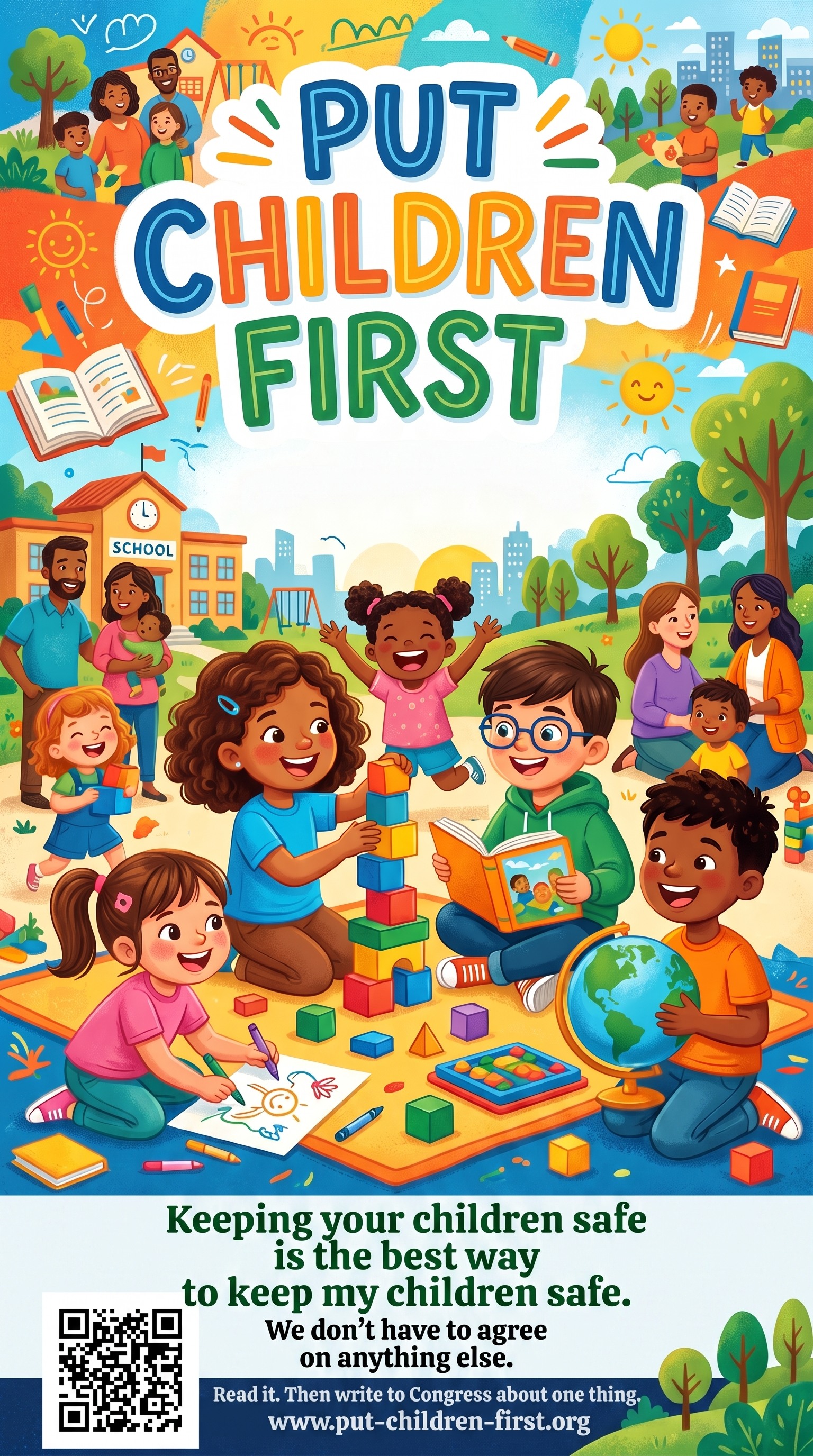
Print it and put it up. A school notice board, a library, a break room, a church hall. The code goes to this page.
Four sheets, ready to print on ordinary US Letter paper: business cards, twelve to a sheet; quarter sheet handbills, four to a sheet; bumper stickers, two to a sheet; and the full page poster. Print at actual size, not fit to page, or nothing cuts straight.
For a real sticker on a car, send the bumper sticker print file to a printer or a sticker company. It is 11.5 by 2.67 inches at 300 dots per inch, with an eighth of an inch of bleed on every side.
This is not a partisan request. No party campaigns on the position that other people's children should do badly. Left, right, and center all say they are working for the next generation. The rule on this page only asks each of them to prove it, and it applies the same test to all of them.
The rule fits in one sentence.
Keeping your children safeis the best wayto keep my children safe.We don't have to agree
on anything else.
Everything above is that sentence, priced.
Sources Every number on this page, with its origin.
- Kids' Share 2025Urban Institute: federal spending on children, share of budget, projections
- How Federal Spending is Distributed by AgePenn Wharton Budget Model: spending by age group, FY2025
- Poverty in the United States: 2024US Census Bureau: Supplemental Poverty Measure, child poverty rates
- Child Tax Credit researchCenter on Poverty and Social Policy, Columbia University
- Impacts of the 2021 expanded Child Tax CreditBrookings: employment, nutrition, financial wellbeing
- Lifecycle Benefits of an Influential Early Childhood ProgramHeckman and colleagues: the 13 percent return
- Child Care in America: price and supplyChild Care Aware of America, 2025
- Paid Family Leave Across OECD CountriesBipartisan Policy Center
- Segregation and Resource Inequality Between School DistrictsNew America: revenue gaps across district boundaries
- Why Our Education Funding Systems Are Derailing the American DreamLearning Policy Institute
- Infant mortality: the US compared to other countriesPeterson-KFF Health System Tracker
- One Big Beautiful Bill Act: the Medicaid provisionsGeorgetown Center for Children and Families
- Child and adolescent firearm deathsKFF: national trends by demography and state
- Firearm violence affecting children and teensCenters for Disease Control and Prevention
- Child Marriage in the United StatesEquality Now: state by state status
- State lawmakers continued to weaken child labor protectionsEconomic Policy Institute, 2026
- Corporal punishment in schools is still legal in many statesNational Education Association
- Thirteen states have no minimum age for adult prosecutionEqual Justice Initiative
- 400,000 detentions: what do we know about their children?Brookings
- Educating children and youth experiencing homelessnessSchoolHouse Connection, 2026 fact sheet
- Kids online safety push faces First Amendment hurdlesRoll Call, July 2026
- Childhood poverty costs the US $1.03 trillion in a yearMcLaughlin and Rank, Washington University in St. Louis
- A Roadmap to Reducing Child PovertyNational Academies of Sciences, Engineering, and Medicine: the $800 billion to $1.1 trillion range
- The Children's Climate Risk Report 2026UNICEF: hazard exposure counts, published June 2026
- Global health burden and cost of lead exposureThe Lancet Planetary Health: 765 million IQ points, $6 trillion
- Microplastics and child health: prenatal and early-life exposureScoping review of exposure routes and possible risks
- The costs of environmental disease in children$76.6 billion in a single year, counting lead, mercury, cancer, asthma, and developmental disorders
- Trends in World Military Expenditure, 2025SIPRI: $2.9 trillion in 2025, and the national shares
- Five charts that show the rise of global militarisationAl Jazeera: cumulative spending since 1949
- Projected Costs of US Nuclear Forces, 2025 to 2034Congressional Budget Office: the $946 billion estimate
- Status of World Nuclear ForcesFederation of American Scientists: warhead counts and alert levels
- Global food insecurity and famine from nuclear war soot injectionXia and colleagues, Nature Food, 2022: the famine modeling
- How fear of nuclear winter has helped save the world, so farRobock and Toon, Atmospheric Chemistry and Physics: soot thresholds
- Nuclear Winter, Strategy, RiskJohns Hopkins Applied Physics Laboratory: the case that the soot estimates are too high
- Convention on the Rights of the Child: questions and answersUNICEF
- Multilateral Treaties Deposited with the Secretary-GeneralUN Treaty Collection: signature and ratification status, country by country
- UNCRC (Incorporation) (Scotland) Act 2024In force July 2024: binding duties on public authorities
- Rights of Children and Young Persons (Wales) Measure 2011The duty on Welsh ministers to have due regard to the Convention
- Child Poverty Reduction Act 2018, New ZealandStatutory measures, ten-year and three-year targets, and reporting each budget
- Effects of reductions in US foreign assistanceThe Lancet Global Health: modeling study
- Under-five mortalityUNICEF Data: UN Inter-agency Group for Child Mortality Estimation
- Record number of children victims of grave violations in 2025UN Special Representative for Children and Armed Conflict